Saturday, May 11, 2019

The Sabbath

John 5. Why did Jesus heal on the sabbath?

John 5: The Sabbath 
John 5: 1-17  The Savior
John 5: Suffering

John 5: Sin

John 5: Society
John 5: The Scriptures

John 5: The Son pt1
John 5: The Son pt.2

When was the Sabbath established?
According to Ex 20 why should we remember the sabbath, and for what purpose did it get established?

According to Deuteronomy what else does the sabbath symbolize? 

According to Hebrews 4, what does the sabbath rest symbolize?

For the manna, what did they do differently on the 6th day?  How did the manna act?  On any other day, what happened if you gathered twice what you needed or tried to store it up for more than one day?

In Genesis 1 you have the divine edicts "and God said let there be..."  In Ex 25 -31 you have "the Lord said unto Moses..."  In both passages it follows with the sabbath.  Why?

Friday, May 10, 2019

John 5: Suffering

How long had the man been infirmed?

What did he seek for his suffering?

What circumstantial evidence might there be that kind of healing was really possible?

Why were there so many people there?  Of all those people why do you think Jesus chose him?

Read Matt 9:35ff.  Did Jesus start the day because He had a burden? What made Jesus have compassion?

If He healed all those people in Matt 9, why didn't He heal all those people in John 5?

Read 2 Cor 12:5-10. Why did Paul have infirmities?  What did he ask God for and how did God answer? How did it change Paul's view of his infirmities?

Read 1 Peter 5:10.  When and for what end does God use suffering?

Compare these experiences with John 5.  Did the man get it?

Monday, March 14, 2016

upWORDS Exodus 3:14-15 The Language of PI


Language.  We are always talking about WORDS, let's talk about languages.

Yesterday we read out of Acts 2, how the Spirit's coming was able to diversify tongues so that the disciples could speak (or the hearers could hear) in the language of "every nation".  It was made clear, the Spirit not only empowered them to speak in a language foreign to them, but He gave them "utterance" or "to plainly communicate, declare" the message of the gospel of Christ to "devout men."  Here these men came to Jerusalem from all over the world to celebrate the giving of the Law, and here Peter tells them they were the ultimate lawbreakers, that devout men crucified the Messiah.  But all these things must be...Just like Jesus told His disciples throughout His ministry and the two on the road to Emmaus...

We tied this reverse of language back to Babel in Genesis 11 where the people were of one language and one mind, set against God such that "nothing would be withheld from them." And the pursuit they chose?  A waterproof tower to reach the heavens to protect against a worldwide flood.  So there He confused their language (note, families could still speak together, maybe even tribes) and therefore ensured the fulfillment of His command to go forth and multiply and fill the earth.  Acts 2 was restoration of Genesis 11, so that His message might by the power of the Holy Spirit go out to every tongue, every tribe, every nation.

In Psalms 19, we find that the very Creation, in specific the "heavens" declare in a plain language that goes out to all the earth such that no place does not hear it and comprehend it.  And then He gave the scriptures, the written WORD of God. It's "perfect converting the soul."  What is it the scripture says converts the soul?  Not the language of the heavens, the Word of scripture.  Wow. Universal language, revealed truth, plainly communicated (see Romans 1:16-21).

Ok, so let's get to our upWORD 

upWORDs are to have us look up, to see the Only Wise God, to Him only be Majesty, Glory, Dominion, and Power both now and forever, Amen (Jude 24-25).  Today, it's PI day, so let's look at the language of PI. (note the post time exactly)

PI:  3.14159... it is the number defined as the ratio between the circumference of a circle and its diameter. It is one of five infinitely complex and simple numbers known to man:

0 - nothing
1 - unity, or everything (They Might Be Giants fans love the song, "There's Only One Everything")
e - the natural number (discussion for another day)


i - imaginary number (square root of -1, yep, another day)
π  - pi.  
So what is so significant about pi?  Why is it so interesting to those who believe in a Creator God?  Well, let's look at a couple things.
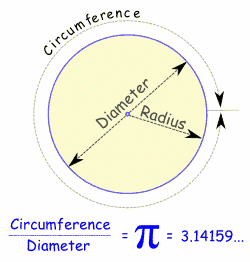
First.  A circle.  

A perfect circle means that it is a polygon (multi-sided figure with equal size sides) with an infinite number of infinitesimal (very very very small) sides.  Approaching an infinite number of sides, π  then goes on forever, no repeating pattern.  Any number that is not whole and has decimal places that goes on forever is an "irrational" number.  1/3 is 0.3333_ repeating.  But 'e' and  π go on without repeating.  In short, to make a perfect circle you need a perfectly imperfect number...
π shows up all over math and physics, not just circles. Anything to do with repeating patterns (like waves), infinite series, even statistics.  If you take two numbers of any size,  it's been proven the odds that they don't have common factors is π /6. Freaky.  
Einstein, Newton, gravitation, electricity and magnetism, quantum mechanics, and the expansion (or collapse) of the universe, all relate to  π .  (I won't bore you with the equations.) In the words of one mathematician "Pi, circles, e, and the Pythagorean Theorem are best friends forever." 


π is FREAKY, MAN!

 Some peculiar things about pi the number.
  • The first 144 digits of pi add up to 666. (the number of a man is "calculated" 666 Rev 13:8)
  • the quadrillionth digit (1,000,000,000,000th) is 0. Really? why that exact digit?
  • Pi is a ratio, but it's been proven to be irrational, which means it can't be a true ratio...
  • According to number theory:
    • Any numerical notation of pi is either an approximation or an abbreviation.
    • Since pi can not be expressed in numbers, pi is not a number.
    • Because pi is not a number, the circumference and the diameter of a circle can not be numbers simultaneously.
    • The qualities of a circle are in that regard not unlike speed and location of a quantum particle, which can also not be simultaneously known. (sorry, lost you on that one)
    • The circle is impervious to a numerical approach and it stands as a symbol for scientific insufficiency.

π in the Bible

So let's look at some verse.  Start with Exodus 3:14-15.  After all, π is  3.1415. Exodus 3 is Moses and the burning bush. Moses asks, "who shall I say is sending me?"  The Almighty speaks from the bush "tell them I AM THAT I AM."  The infinite name.  In verse 15 He goes on to say "this is My name established forever."  Interesting that this passage occurs in 3:14-15.  Coincidence?  Maybe.  Then John 3:14-15.  Just as Moses lifted up the serpent in the wilderness, so must the Son of Man be lifted up and draw all men unto Himself.  That those who believeth in Him should not perish but have eternal life.  (You'll have to look up the story of the bronze serpent to get all that He just said there.)  Wow.

Another interesting thing.  A lot of hubub over the centuries exist about 1 Kings 7:23, which says the circular basin is 10 cubits in diameter and 30 cubits in circumference.  A lot of argument about whether the Bible is wrong because the ratio of the two should be pi, and in this case equals 3, not 3.14159...  One response said this:

What is pi?
Mathematician: Pi is the number expressing the relationship between the circumference of a circle and its diameter.
Physicist: Pi is 3.1415927 plus or minus 0.000000005.
Engineer: Pi is about 3.

What do you think?


Somewhere I read that our search and conundrum with π (and the irrationally infinite) goes back to the garden: the Tree of Life and the Tree of Knowledge of Good and Evil.  Both were part of the first of creation, which some say was absolutely perfect.  Of the Tree one Adam could freely eat, of the other he was forbidden to eat, lest by death he would die.  Sin by definition is not measuring up, anything less than perfection.  Adam, we, I, chose the missing, the just less than perfect.  So the Perfect had to give Himself to die that by death He might overcome death by imperfection.

More importantly, as this is an upWORD, what does this bizarre, complexly simple, profoundly amazing little number tell us about our Infinitely Delightful Brilliant Lord?
Pi, circles, e, and the pythagorean theorem are all best friends forever.

Reference https://www.physicsforums.com/threads/whats-the-significance-of-pi.263423/
Pi, circles, e, and the pythagorean theorem are all best friends forever.

Reference https://www.physicsforums.com/threads/whats-the-significance-of-pi.263423/

Introducing foreWORDs and afterWORDs

http://cdn.mortonsalt.com/wp-content/uploads/our-beginning-3-840x500.jpgI've been teaching Sunday School at all different kinds of levels for as long as I can remember.  Of course I don't remember what I had for lunch, I forget where my keys are, I have no idea if I paid the electric bill this month, and for the life of me what did I do to my leg to make it hurt this morning?!  So take any of my memories with a grain of Morton's...or more as the case may be.


For the last few years I've been sending sporadic emails on foreWORDS--words and scripture references leading to a particular thought or tone as we get ready for the lesson this coming Sunday--and afterWORDS for further consideration.  To make it simpler to find, searchable, and available for someone who wasn't even in the class back then or won't be in the class tomorrow, this blog is where we'll post foreWORDs and afterWORDS and all other kinds of WORDS.  In other words, these are the things you think about leading into a Sunday School class or realize ten minutes after it's over you wish you thought to say. 

My prayer is that you are encouraged, driven to think, and provoked to dig deeper into seeking His character revealed in the passage, all over scripture and in every single facet of your existence.  Most importantly I pray these are not my WORDS but His, and that you might find the love for His Word and the joy of words that I truly believe He wants us to have in pursuing Him as He reveals Himself.

Sunday, January 31, 2016

afterWORD Matthew 7 PART 2 Narrow Gate and Way

Let's start it right this time:
Consider the following literal and cultural context in your thinking about this set of verses, by imagining what the use of these words and the images they might have sparked in the hearers of Jesus in that time and place.  These thoughts are not intended to say that this is absolutely what He meant. Rather meditate on the words in hopes the richer connotations might expound on the history and setting of His sermon and expand your joy in Christ.


Last time we talked about genealogy in context of what some historians describe about the first century and OT Jewish culture and its influence on the hearing of the passage on the tree and its fruit "after its own kind."  Today is entirely literal.  It involves a couple words in the English language--narrow, broad/wide--but in the original language it is four words.  In Matthew 7:13-14 it talks of a narrow gate and narrow way that leads to life and a wide gate and broad way that leads to destruction.  Let's consider these six words.

gate.  Construct in your head the picture of a gate, something on this side leading to the gate, a path or road on the other side. Only don't think of a picket or chain link fence gate like today.  Rather the opening is really the gate, not necessarily just a piece of swinging wood or metal.  It is an opening in a boundary.  Think of the gate of a sheepfold, which may merely be an opening in a foot or two thick stone wall (and the shepherd standing in the gap is the "gate") or even the gates of a walled city like Jericho with 40 ft thick walls. 

wide is the gate.  The original word would conjure a gently sloping wide open field. Spread out and flat. Doesn't sound like much of a boundary, and it would take an incredible hinge if it were chain link or wood.
broad is the way.  spacious, broad.  That does not mean just that it's a wide open field but there's plenty of room to walk and no one pushing against you going the other direction (you'll see in a second).  You can also envision the space in front of you, not really any way to mark your progress walking across a field or a desert (again, you'll see in a second).
"Indeed the safest road to hell is the gradual one - the gentle slope, soft underfoot, without sudden turnings, without milestones, without signposts." - C. S. Lewis The Screwtape Letters

narrow (strait) is the gatenarrow because of obstacles around it (think Straits of Magellan).  The root word this is based on means suffering.  The original language gives an image of an opening so tight that you would have to suffer to squeeeeeze through it, leaving behind anything you carry because it's so tight, and even then it is still painful to pass through. 
narrow is the way. narrow because of a crowd. Literally the word means groaning, affliction, suffering, tribulation, a throng.  It's not that there isn't a wide path, it's that there's difficulty walking forward through all the people pressing against you opposing your progress.  Every step forward is a burden.  Imagine a NY city street, you could get carried the opposite way.  Only, they aren't just traveling in a different direction, they are troubling your progress.  Progress is an important aspect of this word "narrow".

Go back to that picture. A gate, on the incoming side incredible obstacles leading to a painfully tight fit through a potentially thick boundary.  Come out on the other side to meet a way pressed through a throng, a tumult of people, progress is difficult and groaning with persecution.

way that leads to life. This word "way" is little but packs a punch. It means the physical road, the route or directions, the distance, the act of traveling that road, and even the progress along the route being traveled.  All in one little word.  In English we think some of this too but not all at the same time.  The way to the store, I'm on my way (or for you texters, OMW), show me the way, which way, along the way, ONE WAY, WRONG WAY...way too much information?  It's the route to take, the road you walk to get there, and the progress you've made to your destination...sometimes all at once.  Chew on this, we'll come back to it.

It's a sermon:
So why mention this suffering strait gate only found through the obstacles that comes out headlong into the groaning suffering throng way leading to life?

Immediately before v12.  Therefore, all things whatsoever you would that men should do to you, do ye even so to them: for this is the law and the prophets

These are the blessednesses...I have come to fulfill the Law and the Prophets.  These are the true demands of the Law.  Therefore, be the salt. Do all things whatsoever to all the throng that cause groaning, bless those who persecute you, pray for those who spitefully use you...for this is the Law and the Prophets...that leads to life. And there are few who find it (the gate, the way, the life).

Immediate after v15ff.  ...this is the Law and the Prophets...beware of FALSE prophets--ravenous wolves in sheep's clothing.  You have heard by them of old the Law says this, but I say otherwise.  True conversion is a gate amid obstacles.  The true road to life is strait, suffering, through the throng (not with it). And consider those who tell you almost the truth but not quite, the false, the imposter, as the persecutors.  It's not just those who hate the gospel to stand against you in the throng as you pursue faith. It's also those who make it hard to pursue through false teachings, slowing you down, relaxing your pursuit, steering you out of the truth into the high grass where it's harder to walk and see the steps of those who have gone before.  But your job in faith is doing ALL THINGS WHATSOEVER to all men (even those in the throng working against you) as you believe they should do to you--that's the REAL Law and the Prophets!

Is Jesus saying this is the blessednesses (Matt 5) and the true demands of the Law?  Does v12 ring true with Matt 5?  Does true and false ring true with Matt 6?  Is He saying suffering what it takes to do justice, love mercy, and walk humbly with God even if persecuted for righteousness sake is the way to true life?  He is the author (Matt 7:24), and He comes to fulfill the Law and the Prophets (Matt 5).

Want an application?  Well, this is as close as I can get:
1. who for the joy set before Him endured the cross, despising the shame...I AM the WAY, the Truth
, and the LIFE. (Alpha and Omega, the source and the destination, the seed and the exceeding great reward).  No man comes to the Father but by ME.  He is the suffering gate amid obstacles, the groaning way against the throng, and the Life awaiting. 

2. What good father who's son asked for bread would give him a stone.  You want blessing? It's not comfort and relaxation.  That is not true blessing. Poor in spirit, persecuted for righteousness sake, the narrow way--that is true blessing because it gives us Him more perfectly and closely.  for so persecuted they the prophets of old

Every NT writer talks of this:
Acts 9:15-16, Rom 8:15-19, 2 Cor 1: 5, Phil 1:29, Heb 2:10;11:25, James 5:10, I Pet 2:20ff, Rev 2:8-11

3. the light of the body is the eye.  Did you know that if your printer is without black ink, it won't print color pictures correctly?  that's just good advice.  But keep in mind "secret" in the sermon is not the same as darkness.  How you see black and white (truths) changes how you receive colorful joy.  James tells us that persecution is not working against us but actually is evidence God is working for us, to perfect our faith and bring us joy.  James 1:2-4.  What you see is what you get.  So now, for the joy set before you, despise the shame, take up your cross and follow the author and finisher of your faith who was made perfect through suffering

One Sermon.
Part 1 and Part 2 of this afterWORD come together in John 8, starting in verse 31 and really going to the end of the chapter. "then said Jesus to those Jews which believed on Him... "

If you have a few minutes this week, consider the text yesterday with the Jewish culture as you read John 8, looking for the words "seed" and "My word in you" and "father" and "fruit" and "come from".  And then think on today's words in the original language as you read "continue" "life" "free" "keep". 

afterWORD Matthew 7 PART 1 Genealogy

Life Truths Family,
I labored a long time over this week's study of Matthew 7. I am still laboring and worry that the lesson was too much, or uneven. Maybe you got that clue when we finished the small group and introductory discussion with 10 minutes left in class...

I want to offer two critical texts as a follow up that we didn't have what I felt was sufficient time to cover as they deserve (or were too delicate to go into depth), thinking rushing would do it disservice or even cause more harm than good.  The purpose of these two parts, much like the rest of the lesson, is to illumine the whole sermon on the mount as an actual sermon.  We sit as a congregation for a 20-40 minute sermon. But you can easily talk through Matt 5-7 in much less time.  But if you approach it as a sermon, given in one standing, contiguous session to people in a very different culture, you'll have to understand that culture and that setting on the mount to get the richer bigger picture as well as the richer detailed picture.  And flip the tapestry of scripture around to see the threads on the back, and two of the biggest, most colorful knots in this sermon are these two, but to untie them would take significant time and without understanding their colors might cause us to rush and break the strings rather than follow them to fruition.

So I want to take these two in different emails.  Read or dump as you feel necessary. It may take a few minutes to read it all, but hopefully it will be worth your while.

The first is an expansion of "a tree and its fruit" and the second, the broad vs. the narrow way.

word 1. tree and its fruit: genealogy
core phrase: depart from me workers of iniquity, I never knew you.
competitive phrase: did we not prophesy, cast out demons, perform miracles in Your name?
culture:  all Israel is steeped in the first 5 books, and you'll see at the beginning of Matthew he says "this is the genealogy of Jesus," tying the King to the Davidic kingdom as well as to Abraham and the founding of the faith.  It matters what tree you come from.
core word: genealogy - "generations, birth, history, where it came from." 
context: 
   Gen 2:4 - g of creation (though most English versions translate "generations" or "history" it's same word)
   Gen 5 - g of Adam  6 - g of Noah    10-11, 25, 36, 37 and so on.  We call it a family tree.

In creation, He made animals to produce "after their own kind" (Gen 1:20ff) and it repeats in the description of the ark, animals coming in that then repopulate the earth "after their own kind", the ability to reproduce is a definitive function of creation.  When I learned "evolution" as a theory xx years ago, the definition of "species" back then was "two species that breed would have an offspring that was infertile."  The Bible uses the word "kind" and describes it similarly as ability to procreate. 

In the plants (Gen 1:11ff) He says "yielding seed...and fruit after his kind whose seed is in itself..."

With that context, think again "a tree is known by its fruit" it can only produce seed (in its fruit) after its own kind.  It's not a surface picture of an apple tree bearing an orange. Not at all.  It's about the seed within the fruit, that the tree produces after its kind.  It's not a picture of the fruit but the seed carried by the fruit.  Apple tree seeds can only be carried in an apple.  This would be heavily laid on anyone in the Jewish tradition of the scriptures.  Or anyone with any sense of farming or agriculture or husbandry even today.

One last little tidbit, the word "know" in Jewish culture is a euphemism for you-know-what, as it is written in Gen 4:1 "and Adam KNEW his wife Eve, and she bore a son."  If you go back and read the scriptures where God speaks of the seed, it's not a mere standpoint of descendants in a record book.  Activities had to happen to get those people born, very intimate acts.  So when they said "we did these amazing things in Your name" He says, "you're not my children simply because you claim my name, I never knew you, so you are not of the righteous seed."  Or "your fruit is not after righteous kind."  It's not just a symbol of relationship as in we have friends we know very well. 

Workers of iniquity.  This is profound.  You bore iniquity because the Lord wasn't part of the conception.  Consider the child of the bondwoman and the child of promise.  Both produced mighty nations.  Both were offspring in the human sense from Abraham. But the "seed of faith" was when Abraham believed God, not when he tried to accomplish of his own human effort.  God may have blessed Ishmael, but Isaac was fruit of the tree after its kind that led to Jesus. 

Consider going back through all of scripture and studying the word "seed" (suggest KJV or a Strong's concordance to keep the words straight with the original language).  Also the word "fruit" or "tree"
I will put enmity between your seed and the woman's seed...
story of Tamar... (also in Matthew's genealogy)
tree planted by the river, fruit in its season
a farmer sowed seed, in the night the enemy sowed tares in among the wheat...
some fell by the wayside...among thorns...stony ground...fertile soil...bear fruit.
bear fruit that is meet with repentance
fruit of righteousness
fruit of the Spirit...
you must be born again...born of the flesh is flesh, of the Spirit is Spirit...


Ok, I know I know, too much.  Maybe also TMI.  Well let me at least ask the question, "how does this make the Sermon on the Mount one cohesive sermon?"  Well tie it to the beginning and the end.  Matt 5 --blessed are ye BECAUSE the Lord has done all these things (where faith came from)...so bear fruit after its kind.  I came not to abolish the Law, I wrote it! I'm here to fulfill it in your midst. Our Father, Thy kingdom come. Matt 7 -- He taught as one having authority (He was the author) not as a scribe (someone who studies it or copies it).

Next time, Matthew 7:13-14.

Love you folks!  Thanks for reading this far and letting me blab on and on.

Tim

Sunday, December 13, 2015

foreWORD Matthew 1 Good Will

Life Truths Sunday School,
Ever see one of those signs that says "DIP", only they put it right next to the dip and you hit the dip while you're reading the sign?  One comedian once said they should put it after, finding it more valuable as explanation than in warning.  "Whoa, what was that?  OH, the sign says it was a dip!  Ah!"

Anyway, it's 9:27 on Saturday night, and for issues beyond my control but entirely my fault (aka I wrote it two days ago but never hit the send button), here is your "DIP" foreWORD for the morning--you know, 12 hours from now. Well, if nothing else, those who can't be with us can get some fellowship with us on this topic.

We're in Matthew 1 this week and talking of the birth of Christ.  As a foreWORD to the discussion I'd like to jump to Luke.  We know this verse by heart. Pasted below is the Linus version (Charlie Brown Christmas) with the Greek words embedded.  Decide for yourself if you want to have a spotlight and security blanket wrapped around your head while you read it:

Glory δοξα to God θεος in εν the highest υψιστος, and και on επι earth γη peace ειρηνη, good will ευδοκια toward εν men ανθρωπος.

Note highlighted the words "good will".  In Greek, eudokia .  Now look at several other translations of the same verse.  I'll paste a couple below, but to see a much wider array, go to Bible Gateway

“Glory to God in the highest, and on earth peace among those with whom he is pleased!”
HCSB
Glory to God in the highest heaven, and peace on earth to people He favors!
NASB
“Glory to God in the highest, And on earth peace among men with whom He is pleased.”
“Glory to God in the highest, And on earth peace, goodwill toward men!”
NIV
“Glory to God in the highest heaven, and on earth peace to those on whom his favor rests.”


The original sources of these translations differ, but just looking at the words on the page, which one seems closest to the word choices?  Which makes the most sense from what you know of the Living God? 

Let's not stop there. Let's look at the same word in other verses.  See if a tone starts rising.

Luke 10:21 In that hour Jesus rejoiced in spirit, and said, I thank Thee, O Father, Lord of heaven and earth, that Thou hast hid these things from the wise and prudent, and hast revealed them unto babes: even so, Father; for so it seemed good in Thy sight.

Ephesians 1:5-12 Having predestinated us unto the adoption of children by Jesus Christ to himself, according to the good pleasure of His will, To the praise of the glory of His grace, wherein He hath made us accepted in the beloved. In whom we have redemption through His blood, the forgiveness of sins, according to the riches of His grace; Wherein He hath abounded toward us in all wisdom and prudence; Having made known unto us the mystery of His will, according to His good pleasure which He hath purposed in Himself: That in the dispensation of the fulness of times He might gather together in one all things in Christ, both which are in heaven, and which are on earth; even in Him: In whom also we have obtained an inheritance, being predestinated according to the purpose of Him who worketh all things after the counsel of His own will: That we should be to the praise of His glory, who first trusted in Christ.

Philippians 2:13 For it is God which worketh in you both to will and to do of His good pleasure.

2 Thessalonians 1:11-12 Wherefore also we pray always for you, that our God would count you worthy of this calling, and fulfill all the good pleasure of His goodness, and the work of faith with power: That the name of our Lord Jesus Christ may be glorified in you, and ye in Him, according to the grace of our God and the Lord Jesus Christ.

The good pleasure of His goodness, the good pleasure as an outflow of His work in us to will and to do, the good pleasure of His adoption of us in Christ...seems to me His good pleasure of receiving us who have no ability to save ourselves is evidence of His favor resting on us who are saved that the One who gave Himself to save us might be glorified in our pursuing with all abandon our own good pleasure in Him

Maybe another way to ask. Who's favor is it?  His.  Who's good pleasure is it?  yes.  If God is most glorified in me when I am most satisfied in Him, then His good pleasure in me leads to my good pleasure in Him as all satisfying, and that is more glorifying than the whole heavenly host speaking His praises.  For I am living His praise by pursuing Him as my salvation, rescue, joy, peace, hope, and eternal satisfaction.


Ever wonder why God commanded us to love Him?  Doesn't that seem contradictory?  But it's not.  He commands us to love Him because we wouldn't do it otherwise, in fact we're incapable without Him giving us the ability and demonstrating it by loving us first.  And loving Him is far exceedingly great and more precious than anything else He could give His creation.  Giving us the opportunity to love Him who is perfect in all ways is the message behind the message of sending His Son.  Likewise, enjoying loving Him is the message behind the message of loving Christmas.

Now for homework, ask yourself, "who has the peace, is it with God or among the people, and what people?"  In the meantime, I hope to see you all Sunday when we'll just scratch the surface on a few more powerful questions:

Does the Bible tell us to celebrate His birth?

Did Jesus start His life on Christmas or before then?

Did Jesus come here to find humility or did He bring it with Him?

See y'all there.  Be blessed.
Tim
PS Remember the gospel of 'sweat'?  Well, the afterWORD this week will be the gospel of the 'blue string' if I can remember to send it.  Maybe someone should remind me.