Friday, May 31, 2019

John 5: Sin

John 5: The Sabbath
John 5: 1-17  The Savior
John 5: Suffering
John 5: Society
John 5: Sin
John 5: The Scriptures
John 5: The Son pt1
John 5: The Son pt.2

We've gone through John 5 a number of times, finding different perspectives that reveal the various color threads woven together.  Untangling the individual threads that come together in this one passage, we want to trace them through other passages to get an idea what that one thread reveals about the character of God, the nature of man, and the implications on us as we believe.

Read John 5:1-17.  Look again at verse 14.  What would you imply was the source of the man's infirmity?

Read  Matt 9:6, Mark 2:7ff, Luke 5:21ff. What is the difference between those situations and this man's experience?   By the fact that He healed him, was He also forgiving the sin that was the source of it?

Can you have an infirmity that has nothing to do with your sin?  Can you have an infirmity that is the result or consequence of your sin?  Give examples. Can you be forgiven a sin that led to infirmity and yet not be healed of the infirmity?  Why or why not?


What is the definition of sin?

What is the source of sin?

Did the man sin after Jesus healed him and he went and told the church leaders about Jesus (which led to Jesus' persecution)?

Read James 1:13-16.  What are the steps in the process of sin?

Read John 8:34. What is the result of someone sinning? What becomes of them?

Read Romans 1:18-34.  Is sin the cause of dishonor to God or the result of it?  Explain

Read John 3:16.  Why did Jesus come into the world?  Read John 3:17 why didn't Jesus come into the world?

Is sin doing something wrong against God's commandments?  If God's commandments are a description of His character, (God is truth, therefore thou shalt not bear false witness), how else would you describe sin in context of the commandments?

Do I lie and therefore become a liar, or am I a liar and therefore I lie? If someone tells you a lie, what do you call them? If someone steals what do you call them?  If someone cheats on their spouse, what do you call them?  If someone takes someone else's life maliciously, what do you call them?  If someone takes God's name as a curse word or uses it in a way that doesn't give Him the glory He deserves, what do you call them? If someone worships a created thing and not the Creator, what do you call them?

If the man in John 5 (and the other passages) was healed (something he is) by being forgiven (something he did that caused infirmity), is sin about something I do or something I am that merely presents itself by what I do as a symptom of what I am?

Should we merely ask forgiveness for what I did or also ask forgiveness for what I am (a liar, thief, adulterer at heart, idolator, blasphemer...)?  Is sin more than doing wrong things? Is forgiveness more than getting relieved of the punishment of doing wrong things?

Read Romans 3:23, 5:8, 6:23, and 10:9-10.  Describe the relationship of sin, our character, God's character, and the cross.

Wednesday, May 22, 2019

John 5 : Society

John 5: The Sabbath 
John 5: 1-17  The Savior
John 5: Suffering

John 5: Society

John 5: Sin

John 5: The Scriptures

John 5: The Son pt1
John 5: The Son pt.2

 so often talk of context in the Bible in terms of other verses,  sometimes historical and on occasion social context based on what we know of first century Palestine,  but it can be tough to pr ourselves as 21st century Americans into the emotional state of a person in the story. Try, through the following questions to recognize your own preconceived notions.

1. Have you ever missed a meal for lack of money? What other than hunger might you feel in that circumstance? What if you regularly missed meals for lack of money? Or no sure income and little or no way to earn?

2. Where do you turn when you have nothing? If you have nothing because of a disability? What if there were no insurance? Welfare? Medicaid? Or even government like we have?

3. Have you ever had an illness or injury? Evrr had that for more than a few days? What if there was no medicine or doctors? Did you ever wonder if it was because you sinned against God? Have you ever looked at someone with a disability and immediately assumed they had sinned?

4. How long had he suffered with an infirmity?

5. What did he say when Jesus asked if he wanted healed?  Why didn't he say yes?

6. Do you think he felt his suffering was due to sin? Why or why not? What would contribute to that?

7. Have you ever taken one day in the week and done no work at all, not even traveling or carrying more than a pound, or prepared for it to the point of doing even your cooking the day before?

8.  Did the church leaders show excitement for his healing? Why or why not?

9. Why was the man so willing to give up Jesus to the church leaders as the man who told him to carry his bed on the sabbath?

10.  Read Has anyone died because of your failure to do right? Read Lev 17:11. Have you ever killed an animal, shed its blood because you had done wrong or not done what pleased God? Have you ever even looked at one of your sins, just one time you lied, stole, or wanted something belonging to someone else, and thought that the punishment for your crime is death?

11. Have you ever thought of the stuff that is in you that puts you in a position to choose to lie, cheat, steal, defy the sabbath, make gods of created things, lust, or use His name in any way less than He deserves is a disease that will be the death of you?  Read Hebrews 9:22. So what is the only thing that can put that disease in remission?

12.  In that Hebrew society, you are poor and unable to work. You put your whole hope of relief in waiting for an angelic event. Some stranger walks by and asks if you want healed of the infirmity.  What would you answer?  What would you do if He healed you and told you to carry your bed on the sabbath? What would you do if the church leaders asked you why you were carrying your bed on the sabbath?

13. Now come back to 2019 America.  Does our society shun sin? Do we ever think illness is caused by sin? Do we believe in supernatural healing? Do we believe healing comes from God?


What should we believe?


Saturday, May 11, 2019

otherWORDS: John 5: The Savior

In our study of "Wrestling Basics" this spring and early summer in the Grace Baptist Student Ministry, we're going to do the opposite of what we've done all year.  We've tried to synthesize a given Bible text with other places in the Bible that help expand and expound on that text.  Now we want to sit in a single passage for a good while and bring everything back to the core principles being taught in that passage. Much like when Jacob wrestled all night, we want to take a truth and wrestle with it and not let it go until it blesses us.

In otherWORDS, rather than looking at the back of the tapestry of scripture to see how all the various colored strands come together in the knot, we want to start with the knot and see how a single color strand in that knot is true throughout all of scripture and all of Creation because each color strand is just one of the millions of hues in the color palate of God's unchanging character.

John 5: The Sabbath
John 5: 1-17  The Savior
John 5: Suffering
John 5: Sin
John 5: Society
John 5: The Scriptures
John 5: The Son pt1
John 5: The Son pt.2


In this passage we have a set of interesting questions to ask.  Why did Jesus heal this man on the Sabbath?  You might start by asking if Jesus happened by him and just decided of the multitude of people in that place by the pool of Bethesda, that this random man (who happened to have been sick for 38 years) was a good candidate to be healed.

1. What did Jesus ask the man?  Did the man answer His question?

2. Was this a miracle? What is the proof it was a miracle?

3. Was this a salvation experience as you understand salvation?  What is the proof it was or wasn't?

4. What is missing in the story that would indicate anyone in the story had an encounter with the Savior and was saved from their sin?

5. Can you think of another story in the Bible that would be a better example of Salvation and not just Healing?

The Sabbath

John 5. Why did Jesus heal on the sabbath?

John 5: The Sabbath 
John 5: 1-17  The Savior
John 5: Suffering

John 5: Sin

John 5: Society
John 5: The Scriptures

John 5: The Son pt1
John 5: The Son pt.2

When was the Sabbath established?
According to Ex 20 why should we remember the sabbath, and for what purpose did it get established?

According to Deuteronomy what else does the sabbath symbolize? 

According to Hebrews 4, what does the sabbath rest symbolize?

For the manna, what did they do differently on the 6th day?  How did the manna act?  On any other day, what happened if you gathered twice what you needed or tried to store it up for more than one day?

In Genesis 1 you have the divine edicts "and God said let there be..."  In Ex 25 -31 you have "the Lord said unto Moses..."  In both passages it follows with the sabbath.  Why?

Friday, May 10, 2019

John 5: Suffering

How long had the man been infirmed?

What did he seek for his suffering?

What circumstantial evidence might there be that kind of healing was really possible?

Why were there so many people there?  Of all those people why do you think Jesus chose him?

Read Matt 9:35ff.  Did Jesus start the day because He had a burden? What made Jesus have compassion?

If He healed all those people in Matt 9, why didn't He heal all those people in John 5?

Read 2 Cor 12:5-10. Why did Paul have infirmities?  What did he ask God for and how did God answer? How did it change Paul's view of his infirmities?

Read 1 Peter 5:10.  When and for what end does God use suffering?

Compare these experiences with John 5.  Did the man get it?

Monday, March 14, 2016

upWORDS Exodus 3:14-15 The Language of PI


Language.  We are always talking about WORDS, let's talk about languages.

Yesterday we read out of Acts 2, how the Spirit's coming was able to diversify tongues so that the disciples could speak (or the hearers could hear) in the language of "every nation".  It was made clear, the Spirit not only empowered them to speak in a language foreign to them, but He gave them "utterance" or "to plainly communicate, declare" the message of the gospel of Christ to "devout men."  Here these men came to Jerusalem from all over the world to celebrate the giving of the Law, and here Peter tells them they were the ultimate lawbreakers, that devout men crucified the Messiah.  But all these things must be...Just like Jesus told His disciples throughout His ministry and the two on the road to Emmaus...

We tied this reverse of language back to Babel in Genesis 11 where the people were of one language and one mind, set against God such that "nothing would be withheld from them." And the pursuit they chose?  A waterproof tower to reach the heavens to protect against a worldwide flood.  So there He confused their language (note, families could still speak together, maybe even tribes) and therefore ensured the fulfillment of His command to go forth and multiply and fill the earth.  Acts 2 was restoration of Genesis 11, so that His message might by the power of the Holy Spirit go out to every tongue, every tribe, every nation.

In Psalms 19, we find that the very Creation, in specific the "heavens" declare in a plain language that goes out to all the earth such that no place does not hear it and comprehend it.  And then He gave the scriptures, the written WORD of God. It's "perfect converting the soul."  What is it the scripture says converts the soul?  Not the language of the heavens, the Word of scripture.  Wow. Universal language, revealed truth, plainly communicated (see Romans 1:16-21).

Ok, so let's get to our upWORD 

upWORDs are to have us look up, to see the Only Wise God, to Him only be Majesty, Glory, Dominion, and Power both now and forever, Amen (Jude 24-25).  Today, it's PI day, so let's look at the language of PI. (note the post time exactly)

PI:  3.14159... it is the number defined as the ratio between the circumference of a circle and its diameter. It is one of five infinitely complex and simple numbers known to man:

0 - nothing
1 - unity, or everything (They Might Be Giants fans love the song, "There's Only One Everything")
e - the natural number (discussion for another day)


i - imaginary number (square root of -1, yep, another day)
π  - pi.  
So what is so significant about pi?  Why is it so interesting to those who believe in a Creator God?  Well, let's look at a couple things.
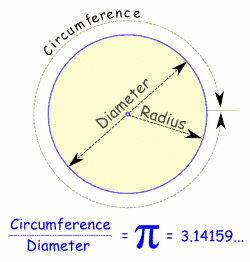
First.  A circle.  

A perfect circle means that it is a polygon (multi-sided figure with equal size sides) with an infinite number of infinitesimal (very very very small) sides.  Approaching an infinite number of sides, π  then goes on forever, no repeating pattern.  Any number that is not whole and has decimal places that goes on forever is an "irrational" number.  1/3 is 0.3333_ repeating.  But 'e' and  π go on without repeating.  In short, to make a perfect circle you need a perfectly imperfect number...
π shows up all over math and physics, not just circles. Anything to do with repeating patterns (like waves), infinite series, even statistics.  If you take two numbers of any size,  it's been proven the odds that they don't have common factors is π /6. Freaky.  
Einstein, Newton, gravitation, electricity and magnetism, quantum mechanics, and the expansion (or collapse) of the universe, all relate to  π .  (I won't bore you with the equations.) In the words of one mathematician "Pi, circles, e, and the Pythagorean Theorem are best friends forever." 


π is FREAKY, MAN!

 Some peculiar things about pi the number.
  • The first 144 digits of pi add up to 666. (the number of a man is "calculated" 666 Rev 13:8)
  • the quadrillionth digit (1,000,000,000,000th) is 0. Really? why that exact digit?
  • Pi is a ratio, but it's been proven to be irrational, which means it can't be a true ratio...
  • According to number theory:
    • Any numerical notation of pi is either an approximation or an abbreviation.
    • Since pi can not be expressed in numbers, pi is not a number.
    • Because pi is not a number, the circumference and the diameter of a circle can not be numbers simultaneously.
    • The qualities of a circle are in that regard not unlike speed and location of a quantum particle, which can also not be simultaneously known. (sorry, lost you on that one)
    • The circle is impervious to a numerical approach and it stands as a symbol for scientific insufficiency.

π in the Bible

So let's look at some verse.  Start with Exodus 3:14-15.  After all, π is  3.1415. Exodus 3 is Moses and the burning bush. Moses asks, "who shall I say is sending me?"  The Almighty speaks from the bush "tell them I AM THAT I AM."  The infinite name.  In verse 15 He goes on to say "this is My name established forever."  Interesting that this passage occurs in 3:14-15.  Coincidence?  Maybe.  Then John 3:14-15.  Just as Moses lifted up the serpent in the wilderness, so must the Son of Man be lifted up and draw all men unto Himself.  That those who believeth in Him should not perish but have eternal life.  (You'll have to look up the story of the bronze serpent to get all that He just said there.)  Wow.

Another interesting thing.  A lot of hubub over the centuries exist about 1 Kings 7:23, which says the circular basin is 10 cubits in diameter and 30 cubits in circumference.  A lot of argument about whether the Bible is wrong because the ratio of the two should be pi, and in this case equals 3, not 3.14159...  One response said this:

What is pi?
Mathematician: Pi is the number expressing the relationship between the circumference of a circle and its diameter.
Physicist: Pi is 3.1415927 plus or minus 0.000000005.
Engineer: Pi is about 3.

What do you think?


Somewhere I read that our search and conundrum with π (and the irrationally infinite) goes back to the garden: the Tree of Life and the Tree of Knowledge of Good and Evil.  Both were part of the first of creation, which some say was absolutely perfect.  Of the Tree one Adam could freely eat, of the other he was forbidden to eat, lest by death he would die.  Sin by definition is not measuring up, anything less than perfection.  Adam, we, I, chose the missing, the just less than perfect.  So the Perfect had to give Himself to die that by death He might overcome death by imperfection.

More importantly, as this is an upWORD, what does this bizarre, complexly simple, profoundly amazing little number tell us about our Infinitely Delightful Brilliant Lord?
Pi, circles, e, and the pythagorean theorem are all best friends forever.

Reference https://www.physicsforums.com/threads/whats-the-significance-of-pi.263423/
Pi, circles, e, and the pythagorean theorem are all best friends forever.

Reference https://www.physicsforums.com/threads/whats-the-significance-of-pi.263423/

Introducing foreWORDs and afterWORDs

http://cdn.mortonsalt.com/wp-content/uploads/our-beginning-3-840x500.jpgI've been teaching Sunday School at all different kinds of levels for as long as I can remember.  Of course I don't remember what I had for lunch, I forget where my keys are, I have no idea if I paid the electric bill this month, and for the life of me what did I do to my leg to make it hurt this morning?!  So take any of my memories with a grain of Morton's...or more as the case may be.


For the last few years I've been sending sporadic emails on foreWORDS--words and scripture references leading to a particular thought or tone as we get ready for the lesson this coming Sunday--and afterWORDS for further consideration.  To make it simpler to find, searchable, and available for someone who wasn't even in the class back then or won't be in the class tomorrow, this blog is where we'll post foreWORDs and afterWORDS and all other kinds of WORDS.  In other words, these are the things you think about leading into a Sunday School class or realize ten minutes after it's over you wish you thought to say. 

My prayer is that you are encouraged, driven to think, and provoked to dig deeper into seeking His character revealed in the passage, all over scripture and in every single facet of your existence.  Most importantly I pray these are not my WORDS but His, and that you might find the love for His Word and the joy of words that I truly believe He wants us to have in pursuing Him as He reveals Himself.